Saturday, 25 June 2016

The Pièce de Résistance of Benedict Cumberbatch

Benedict Cumberbatch as Richard III in The Hollow Crown
Now is the winter of our discontent
Made glorious summer by this son of York;
   
     This post is not so much trying to convince you to watch Richard III – Benedict Cumberbatch having top billing is enough for most people – as to look at what makes Benedict's performance in this famous roll unique.

     To put it simply, I think his acting is incomparable and here's why!


Benedict Cumberbatch as Richard III in The Hollow Crown

Why, this it is, when men are rul’d by women: 
’Tis not the King that sends you to the Tower; 
My Lady Grey his wife, Clarence, ’tis she 
That tempers him to this extremity.


Mean time, this deep disgrace in brotherhood 
Touches me deeper than you can imagine.

 
Go tread the path that thou shalt ne’er return: 
Simple plain Clarence, I do love thee so 
That I will shortly send thy soul to heaven    

     This third installment of The Hollow Crown: Wars of the Roses shifts the focus from the warring red and white blooms to the sharpest thorn of the white rose, that infamous Richard. From here on out he drives the plot, and Benedict handles the role so masterfully that we in the audience are enthralled as we are reluctantly driven along by this charismatically murderous man.


Benedict Cumberbatch as Richard III in The Hollow Crown


Was ever woman in this humor woo’d?
Was ever woman in this humor won?
I’ll have her, but I will not keep her long.
What? I, that kill’d her husband and his father,
To take her in her heart’s extremest hate,
With curses in her mouth, tears in her eyes...
And yet to win her! All the world to nothing! Hah!

     If it is possible, the gentleman keeps surpassing himself, and the case of Richard III is no exception. He is so villainous that the film leaves you huddling in the corner while you applaud in speechless awe. He reaches the ultimate in being both subtle and dynamic. There are hundreds of tiny nuances to catch if you watch him closely, while at the same time his character explodes off the screen because there is so much energy and power coming from him.

     And the fact that he happens to be in the starring role makes this film just too tempting to miss.

Benedict Cumberbatch as Richard III in The Hollow Crown


     "Subtle, sly and bloody" – that is how Richard's mother describes him, and that is exactly what we see. The screenwriters and director Dominic Cooke did an excellent job in purposefully narrowing the focus down to Richard over the three films, by tracking how he got to the throne and how and why he turned out as he did. They were wise enough to achieve this focus by giving the audience ample shots of Benedict's face. Of course the nature of Shakespeare's play already gives Richard many opportunities to show his face to the audience with his asides and soliloquies. But it is satisfying to see how those involved in the film went even further in that important particular, and have many shots of Benedict when he isn't speaking to the audience (or speaking at all).

     This brings me to one advantage that film sometimes has over live theater. When we are watching a group of actors on the stage it is impossible to see the reactions of every character, especially of those who aren't speaking. But in a film like this every expression of Benedict's is put right in front of our eyes. I don't always appreciate this fact in other films, but, as I've already said, every moment of his performance is riveting, so in this case I say it is an excellent idea.

Benedict Cumberbatch as Richard III in The Hollow Crown

Then be your eyes the witness of their evil.
Look how I am bewitch’d; behold, mine arm
Is like a blasted sapling, wither’d up;
And this is Edward’s wife, that monstrous witch...
If? Thou protector of this damned strumpet,
Talk’st thou to me of “ifs”? Thou art a traitor.
Off with his head!


     Another way in which they took their queue from Shakespeare is in the almost exaggerated theatricality of Richard, in both his actions and his speech. Richard Gloucester is such a drama queen! (Sound familiar Sherlock fans?) Now an actor could easily overdo this, but of course Benedict is the master of playing emotionless men who can convincingly feign every emotion under the sun. He is the master actor playing the master manipulator, and he does so, perfectly!

Benedict Cumberbatch as Richard III in The Hollow Crown


     In Henry VI Part Two we saw the beginnings of Richard's skills in manipulation via taking on whatever rôle would best serve his own ends, and now in Richard III we see him use those skills with the expertise of a surgeon wielding a scalpel. He gets an idea into his head, and then we sit back and watch him put all of his skill into action to achieve his ends by playing on peoples' emotions, spreading rumors, pointing fingers, painting himself as the the victim, and threatening people to take his side. Part of the power of Benedict's performance, and of the role itself, is that we as the audience always know Richard is manipulating people with his displays of emotion (because he tells us), yet at the same time he is so effective that we almost have to applaud the skill of his performance. But still more dazzling is how believable Benedict is as he brings Richard to life.

Benedict Cumberbatch as Richard III in The Hollow Crown


     Richard tells us outright that he is subtle, false and treacherous, plotting murder after murder unapologetically, and it is this brazen energy that Benedict captures and keeps us riveted to the screen. Not for one second does Benedict's performance lose that zeal and relentless ambition. It actually gains a sort of fanatical determination as he begins loosing his dubious grip on the crown, so that when the film finally ends you're sitting there breathlessly coming to grips with this turning, twisting, racing, remorseless ride you've just endured.

Benedict Cumberbatch as Richard III in The Hollow Crown
Cousin, thou wast not wont to be so dull. Shall I be plain? I wish the bastards dead, And I would have it suddenly perform’d. What say’st thou now? Speak suddenly, be brief.
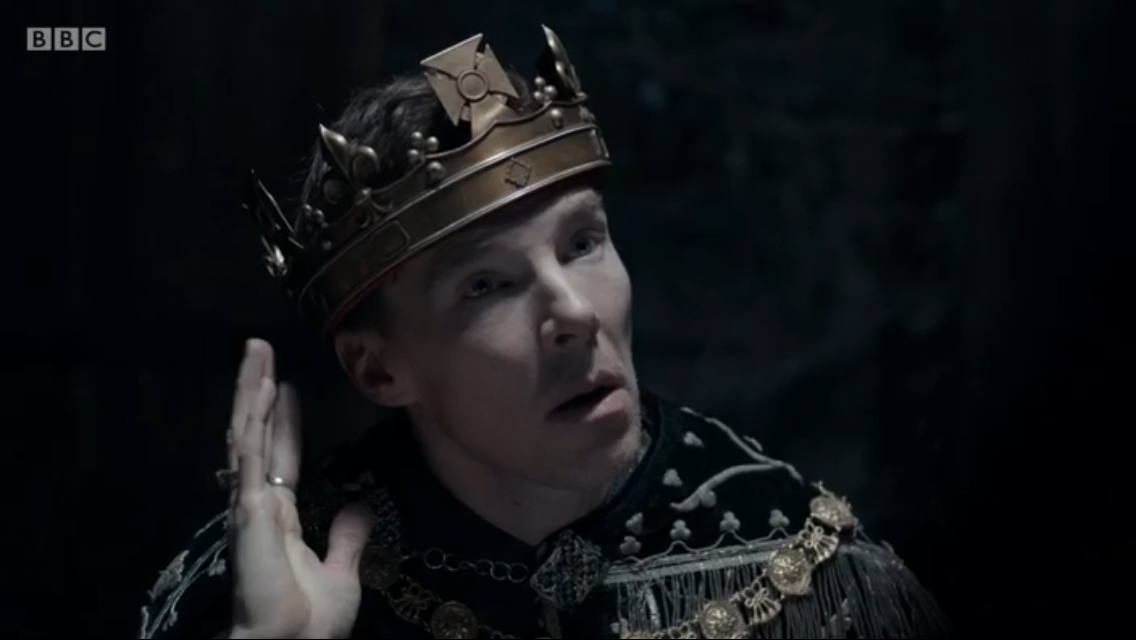

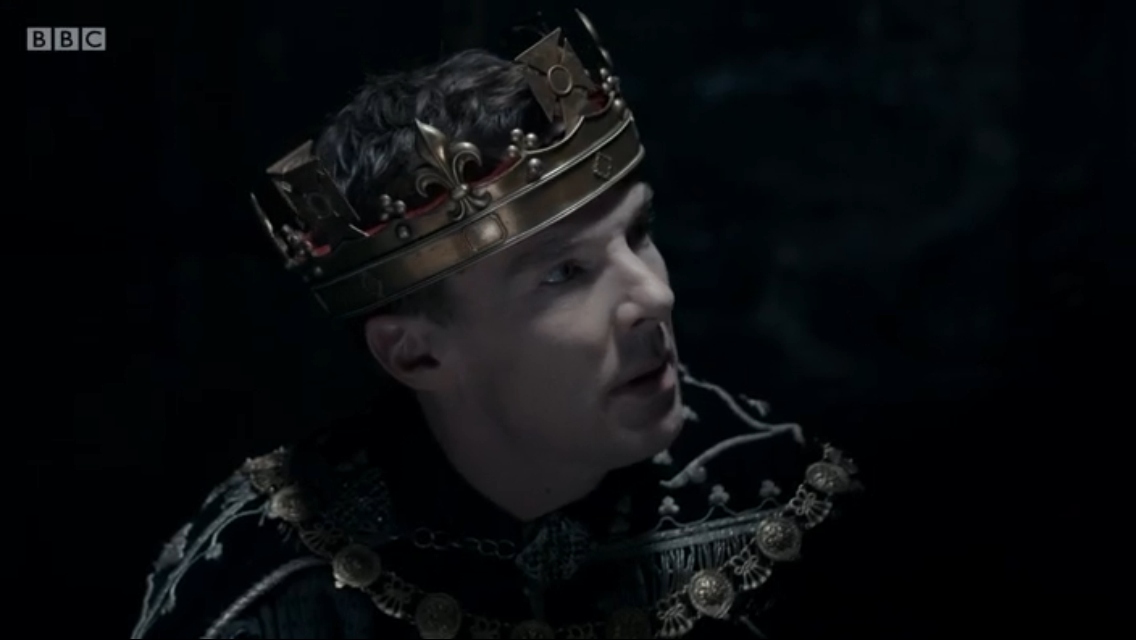


     Now I've seen a few movies that wrung me out by the end of them and kept me thinking for a long time afterwards. But there was an unusual power in this one. Benedict is so real as Richard that I feel as if I've actually seen all of this happen – all of the plotting, ambition, murders, manipulation, revenge and heartlessness – and it is no easy thing to watch. That a human being could have done all that Richard does – and it is possible that the real Richard did a majority of it – is disturbing, and Shakespeare adds to that in the construction and dialogue of his play. Then Benedict grabs it and runs with it – straight in the direction Shakespeare pointed.

     Benedict Cumberbatch has a gift for stretching any role to it's furthest limit while being able to keep his acting at the highest pitch of naturalness. Richard is a role where those limits stretch very far indeed, and it is possible for an actor to misread the direction and get slightly off by making him too theatrical and melodramatically villainous, especially with his physical deformity. But Benedict, by adhering to the standard of the natural, makes Richard as terrifying as possible because he tries – and succeeds – to make the villain real.

Benedict Cumberbatch as Richard III in The Hollow Crown
If I be so disgracious in your eye, 
Let me march on and not offend you, madam. 
Strike up the drum.


     His Richard is theatrical, but theatrical in a real way. He hunches over and limps like any conventional villain might, but Benedict has obviously studied how that physicality would really effect a man's body. He gleefully boasts of his plans to the audience, but Benedict understands where Richard has come from, that his quickness is natural and his ambition was fed by the war for power he's been a part of all his life. He acts the way a clever person would when they get caught up in the enjoyment of their own plans and ability to manipulate – he understands that the frailty of genius is that it needs an audience. Even his speech is changed to reflect the character, with precise and punching consonants that seem so natural for the conspicuously dramatic Richard.

     What he does is sheer brilliance! He brings this legendary character to life with startling skill. It feels like you've met Richard, and the effects of that meeting are completely terrifying and captivating all at once.

     I would argue that what makes his Richard uniquely powerful is his ability to become the character so completely, from every explosion of manipulative emotion, down to the smallest raise of the eyebrow.

Benedict Cumberbatch as Richard III in The Hollow Crown
Plots have I laid, inductions dangerous...
     He is bringing Shakespeare to life for a new generation – I know this phrase may be a bit of a cliché at the moment, but it's so accurate that I have to use it! – and it is thrilling to be here to see it happen!


© Anna Morton 2016
Sunday, 19 June 2016

The Hidden Gem of Olney

| The adorable 18th century town of Olney |
| The adorable 18th century town of Olney |

England Trip 2015

     While we stayed in Luton we took a day trip over to the quaint little town of Olney, known for its connection to John Newton (the writer of the hymn 'Amazing Grace') and William Cowper, one of Jane Austen's favorite poets. It is a pleasant, traditional little town that has everything within walking distance, including the church of John Newton, the Cowper Museum, many charming shops and a delicious tea room and deli. It's also set in the picturesque, peaceful English countryside of Buckinghamshire.

Amazing grace! how sweet the sound,
  That saved a wretch; like me!
I once was lost, but now am found,
  Was blind, but now I see.
John Newton 

Olney on a map
Where Olney is located in relation to London.
     We parked for free on the high street, then walked the short distance across the town square (where sits the public parking lot) to the Cowper and Newton Museum. The town has a delightful 18th century feel to it, even to this day! Probably because so many of the buildings have been around since then (and, in my case, because William Cowper lived here in that same century). Yet at the same time it feels like a living, breathing town where people still live their daily lives. To me that is the ideal scenario. If a town can keep it's historical atmosphere while people enjoy and maintain it by way of living in it, then it's like the past and the present can survive at the same time! I think it's marvelous. And Olney is an excellent specimen of this very thing!

Parking in Olney
The handy parking spaces along the high street.
Olney town square
Olney town square (we parked down the street to the left, and the Cowper Museum is the larger brick building just to the right of the parking lot above).
The lovely facade of the Cowper & Newton Museum and Gardens
     The museum was closed by the time we arrived, but it is still worthwhile to take a look at the outside. This is the house where the poet William Cowper lived while he was staying in Olney and working with John Newton on their collection of hymns, so on display in the museum are possessions belonging to Cowper and Newton that give you some insight into the retiring yet important lives of these two religious and literary men of the 18th century.

     On a visit three years ago I was able to go inside and take the self-guided tour. You can go around the pleasant sunny little house, into the bedrooms, parlor, dining room, etc., and into the peaceful garden at the back – a place that would certainly inspire a poetic mind like William Cowper's. The garden has been reconstructed to look as it would have done while he lived there in the late 1700s, filled with flowers and shrubs, and containing a little pond and outbuilding where Cowper used to go when he wished to be alone and write.

Cowper's writing desk
God moves in a mysterious way
His wonders to perform;
He plants His footsteps in the sea
And rides upon the storm.
William Cowper

The lovely garden at the Cowper and Newton Museum

The lovely garden at the Cowper and Newton Museum

     After wishing we could go in the museum Mom and I wandered along to "Newton's Church" (a.k.a. St. Peter and St. Paul Church), a few blocks away. Just before you reach the church there is a small field with a couple of ponies grazing, so we had to stop and say hello. :)

     The church is left unlocked (most churches are in the English countryside – I'm not sure why, but I'm glad, since it's convenient for us!), so we took peek inside. It's still a working church, so there is a nursery set up, along with a little library and an interesting spread of postcards and flyers letting people know what ministries and events the congregation has going on. It's lovely getting to see a slice of real life! It is hard to imagine worshiping here every Sunday, in a place that has been around for centuries, and where John Newton actually used to preach. But this is England, and there are famous old things everywhere, so a person almost gets used to it. 

St. Peter and St. Paul Church
The impressive tower of St. Peter and St. Paul Church
"Newton's Church" (a.k.a. St. Peter and St. Paul Church)
Looking out at the congregation
"Newton's Church" (a.k.a. St. Peter and St. Paul Church)
Looking toward the choir and the pulpit.

     One of my favorite things in this place is the nursery – or rather what's in the nursery...

John Newton's pulpit in the nursery
"Please mind your head on the pulpit."

     "Don't hit your head on John Newton's pulpit!" Now that's not something you hear in every church nursery. ;)

     We grabbed a few brochures, dropped some change in the box for our postcards and headed back out into the sunshine. It was a bit sunnier by then, which was nice for our walk around the churchyard. We went in search of John Newton's grave, of course, and then let ourselves think on the reality of death and the hope of heaven as we walked among the headstones, many of them over two centuries old and nearly impossible to read.

The Lord hath promised good to me,
  His word my hope secures;
He will my shield and portion be
  As long as life endures.

John Newton and his wife were buried together. (This is a new gravestone, by the way.)

Olney churchyard
Olney churchyard
When we’ve been there ten thousand years,
  Bright shining as the sun,
We’ve no less days to sing God’s praise
  Than when we first begun.

     It's sad to walk around so many gravestones and think about death, but at the same time it is amazing to think that the man who wrote these words has been singing God's praise in God's actual presence for more than two centuries! [Along with every other person in that churchyard (and everywhere else) who has believed in Jesus Christ and his amazing grace! :)]

     On our way to have a spot of tea we looked in a few shops – especially the charity shop, where the displays of Easter hats were most tempting. The town center and the high street have a good number of fun shops and boutiques to wander about in. The little deli is on one corner of the town square and the high street, and it's easy to spot with its green and white awnings.


     You can order at a counter surrounded by shelves lined with preserves and glass cases filled with desserts, cheese, pies and more, or you can sit down at one of the little tables in the next room for a cup of tea and some lunch. We chose the latter, since it's a very pleasant thing to do after you've been wandering around on your feet all day.

Mom with her slice of cake.
Me enjoying my large piece of sultana cake.

Olney Deli and Tea Room
A look toward the entrance where you can also see some
of the many delicious treasures available to take home!
Olney Deli and Tea Room
Part of the dining room and the pleasant view.


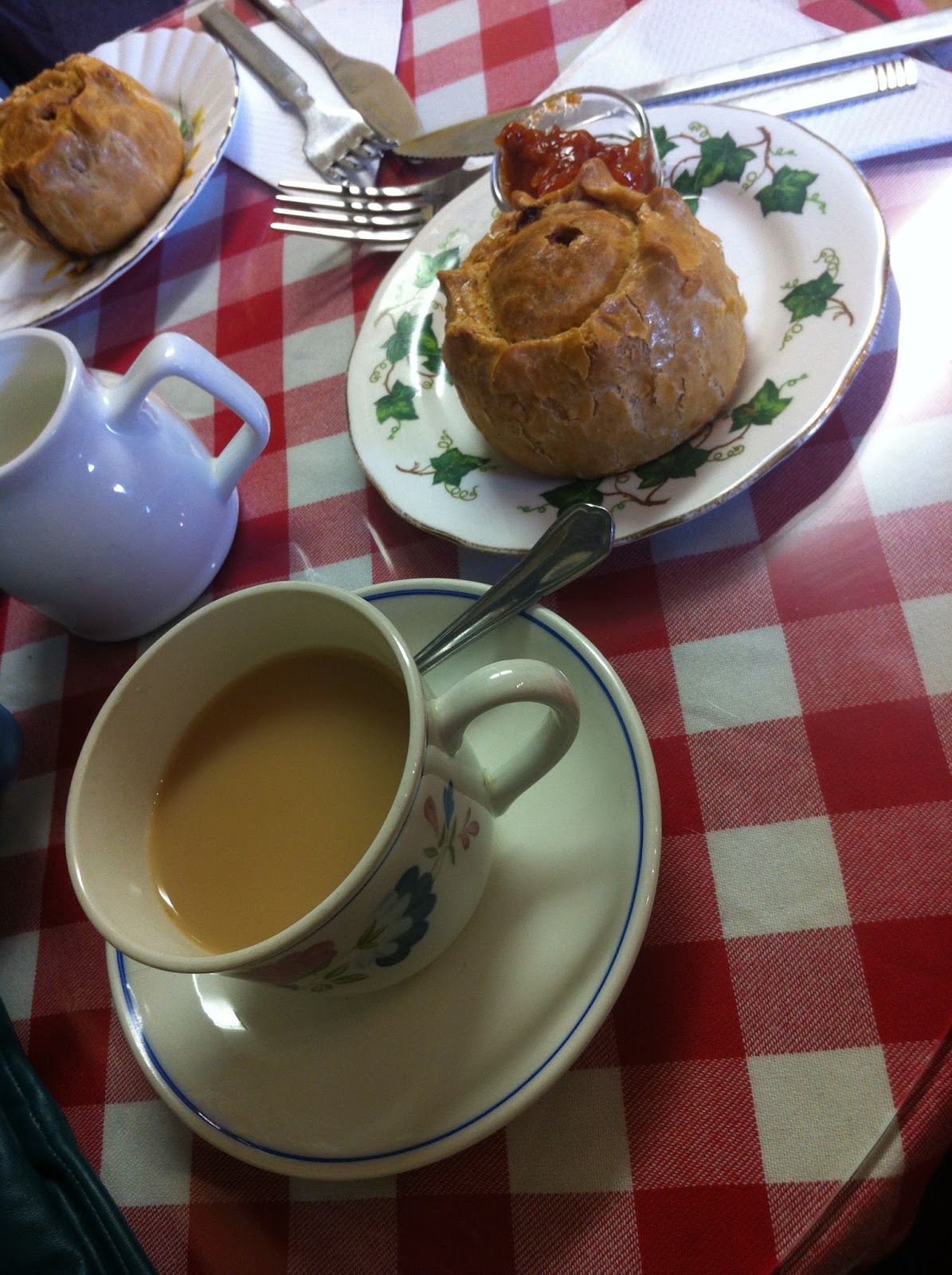
Olney Deli and Tea Room - Pork Pie
For lunch we each had a mini pork pie – an English classic. :)
     Mom had a nice chat with the lovely lady who served us tea – who also happened to have a daughter about my age – and then it was time to think of heading back to Luton. First we made a quick stop at a Tesco Express for some essentials (like strawberries, milk, chocolate...) and the post office for Mom to send some postcards. She is much more diligent in that endeavor than I am. I haven't sent a single one on the entire trip.

Some of the shops near the town center.

     After a short walk down the high street we found the Cowper Memorial sort of tucked back down a small path. It's a pretty little Victorian-looking building built in honor of William Cowper, once used as a center for some sort of charitable work in the town, and is now home to a church. Then it really was time to go, and we made it back to finish the day in the company of our dear friends.

So, for a relaxing day filled with history and pleasant places to walk or sit down to tea, I would recommend this little hidden gem!


© Anna Morton 2016

Friday, 17 June 2016

Tales of a Breadmaking Novice

     
Spelt bread from The Great British Bakeoff: How to Bake cookbook.
     I have officially made my first loaf of bread! Huzzah! This is a momentous occasion after several failed attempts at recipes containing the dreaded yeast. For years it has been my Achilles' heel, but no more!

    Last weekend I attempted the whole grain/spelt bread recipe from The Great British Bakeoff: How to Bake by Linda Collister, and it worked wonderfully! It actually looked like real bread and tasted delicious! It has a soft, slightly crumbly texture and a mild flavor, with the smallest bit of sharpness. It goes beautifully with butter, and can hold its own flavor when dipped in olive oil or soup.


     Now I shall share the secrets that led to my triumph, and hopefully they will help you to avoid the mistakes that tripped me up in the past.

#1: Find a foolproof place for rising


     I always fell at this most important hurdle. I set the bowl on the top of our refrigerator or near a sunny window or on top of the dryer, and yet I would check the progress of my dough in vain. I don't think it ever increased more than 30% – at the most – no matter how long I left it. At least three times I attempted yeast recipes with the same frustrating results... until one day I did something brilliant: I looked on Pinterest!

     Someone on that invaluable website had had a stroke of genius, and came up with a reliable way to keep your dough warm while it rises:
  1. You boil water
  2. Put the boiling water in a pan (or a cup)
  3. Put the covered dough in with the pan in the oven (or put it in the microwave with the cup)
  4. Sit back and watch your dough rise
     This method has not failed me yet! It may not be absolutely foolproof, but it's pretty close since you are placing the dough in a more controlled space than the less-than-predictable air of your kitchen.

     I'm sure many of you have heard of this technique before, but for those of us who are still searching for the key (as I was), I would heartily recommend giving this a try.

Bread dough
The dough doubled in size after sitting in the microwave! So exciting.

#2: Use enough liquid in the yeast paste


     Once I tried a recipe that had me blend the dry yeast with a bit of warm milk – sounds simple, right? Well, it is possible for me to fail even in that. I put in just enough milk to make the yeast clump together in the most unappetizing lumpy mess. I had some misgivings but I thought it would mix together with the rest of the dough and be fine. Wrong. The dough did rise (a little), but even after it was baked the mixture tasted overpoweringly of yeast – and now I know why yeast is not a popular flavor for anything.

     I hope I'm not the only person in history who has ever done that. But I also hope that this little mention of it will keep you from joining me on that list.

The dough after kneading in the salt, olive oil and last batch of flour.

#3: Follow the recipe (and read it all the way through beforehand – maybe two or three times)


     I got a little confused when I read this particular recipe because you add the flour in three batches of 250g. I got confused as to when each batch of flour was supposed to be put in, so I ended up doing things a bit out of order. (I almost ruined it by adding the last batch too soon.)

     Thankfully the recipe wasn't ruined! But I wanted to give this advice because I thought I had read the recipe thoroughly, when it turns out I really hadn't been as thorough as I'd thought.

     I suppose another aspect to this advice is that if you do misread a recipe then you don't necessarily have to panic. Just stop and look at what you're doing, what the recipe is telling you to do next, and how much the mistake will effect the outcome, then decide if it will still turn out – it may be salvageable more often than you'd think!

Spelt bread ready to go into the oven
The dough all ready to go into the oven at last!

     Thanks for reading! In my next post about baking I'll share my experience with grated almond flour pie crust and my first ever cherry pie...


© Anna Morton 2016
     

Tuesday, 14 June 2016

Jane Austen and The Science of Deduction

     I've been thinking about literature again. Once in a while something in my deliberations causes the proverbial light bulb to switch on and I'm inspired to jot it down. Of course, since I have a blog, it makes sense to put it here and share my discoveries with you! I hope in some way it can shed a bit of unexpected light on these timeless classics whose ability to inspire us seems inexhaustible!
     
Jane Austen and Sherlock Holmes

     What do the sparkling Regency novels of Jane Austen have in common with Sherlock Holmes and Sir Arthur Conan Doyle's foggy Victorian London? More than I had ever fathomed until now.

"How could I possibly join them on to the little bit (two inches wide) of ivory on which I work with so fine a brush, as produces little effect after much labour?" Jane Austen
"Their most trivial action may mean volumes, or their most extraordinary conduct may depend upon a hairpin or a curling tongs." Sherlock Holmes, The Adventure of the Second Stain

     Just like Sherlock Holmes, Jane Austen finds importance in the little things, what other people see as trivial and unimportant. In the tales of the detective the conclusion of a case often hangs on a suspect's choice of words or the cleanliness of their shirt because Sherlock tucks away every single word and action in his mind until they add up to form a watertight case.

     With Jane Austen we are meant to play the detective and store up all the little facts so we can construct a case for each character and for our understanding of the story.

     Emma is perhaps the most thoroughly investigative novel, since we experience the story from the point of view of one character, which is of course Emma Woodhouse, and we make judgments along with her. In a way this presents a greater challenge to us as detectives than any Holmes faces in his mysteries because we are influenced by Emma's thoughts upon everything we see and everything that happens, whereas Holmes is always able to view the facts through his own eyes. It is possible to make unbiased judgments when reading Emma, but it is a delicate business trying to follow the thread to the right conclusion without being as unwittingly confused by Emma's perception as she is.

     What do we make of Mr. Elton's wanting Emma to paint Harriet's portrait? Or of Frank Churchill's teasing Jane Fairfax about the piano? Or his tardy visit to Highbury? Or his getting his hair cut? Or Mr. Knightley walking with Harriet at Donwell Abbey? They all seem like unremarkable things until you have finished the novel and can look back to see how they really told you a lot about what was going on and what would follow, and about which characters were truly admirable.

     You think, "Oh, of course! How could I not see that?" – just like in a Sherlock Holmes mystery. He tells you how he knew Watson decided not to invest in South African gold or that it was the wife who stole the secret documents. It was because he observed what he saw – everything that he saw – and put it all together to deduce the true story.

     In my opinion this is one overlooked aspect that gives both Jane Austen's novels and the stories of Sherlock Holmes such enduring appeal. Instead of relying on sensational visuals like violence in epic sagas or the exaltation of love in romances, they seek to understand how the mind works. They are studies in people and what really makes them tick. They expose human weakness and exemplify their strengths by placing people in ordinary places, and offering them apparently insignificant choices that will end up changing the courses of their lives.

     In short, they show that it is the small things that make up life, and that it pays off to see their significance, especially when they relate to people.

     So there it is! Do you think I'm on to something? Or are there any other connections that you've found between the stories?


© Anna Morton 2016