Showing posts with label Tea. Show all posts

Thursday, 14 July 2016

A dream come true in Grantchester and the Orchard Tea Gardens

The Orchard Tea Gardens in Grantchester
     Ever since I saw an article in Victoria magazine about the Orchard Tea Gardens near Cambridge I've dreamed of going there. They conjured up visions of Cambridge University students before the Great War, all dressed in white, sitting among the blossoms, drinking tea and eating scones with honey while they chatted amiably about their exams or their latest poem, and I wanted to be on the spot to pretend to be one of them. Well, I finally managed it!

England 2015 Trip Journal
Tuesday, April 7

     I feel I should be writing poetry since I'm sitting in the Orchard Tea Gardens in Grantchester. It is no mystery to see why Cambridge students liked to come here and sit, contemplating the world around them as they laid back in the lawn chairs smelling the sweet fragrance of apple blossoms, feeling the soft breeze and gentle warmth of spring sunshine as it goes in and out of the clouds. Which is exactly what today is like!

Under the peaceful trees of the Tea Gardens in Grantchester

Under the peaceful trees of the Tea Gardens in Grantchester

The iconic green lawn chairs in the Orchard Tea Garden

Baskets heaped with the perfect scones
Baskets heaped with the perfect scones.

     Ah! You lean your head back and close your eyes, and you can hardly open them again they become so instantly comfortable. As soon as we walked into the pavilion with the kitchen we were greeted with the smell of fresh, hot scones – I could even see a huge pile of them on the baking trays covered with cloths behind the counter. Proper scones, they are: big, golden, and halfway between airy and dense. They are the quintessential scones. And once you slather them with dollops of butter, clotted cream, honey and strawberry jam, the result is glorious.

I present to you the perfectly delicious scone of the Orchard Tea Garden!

My lunch: ham, cheese, bread, an apple and 3 chutneys.

Mom's delicious quiche from the tea pavilion.
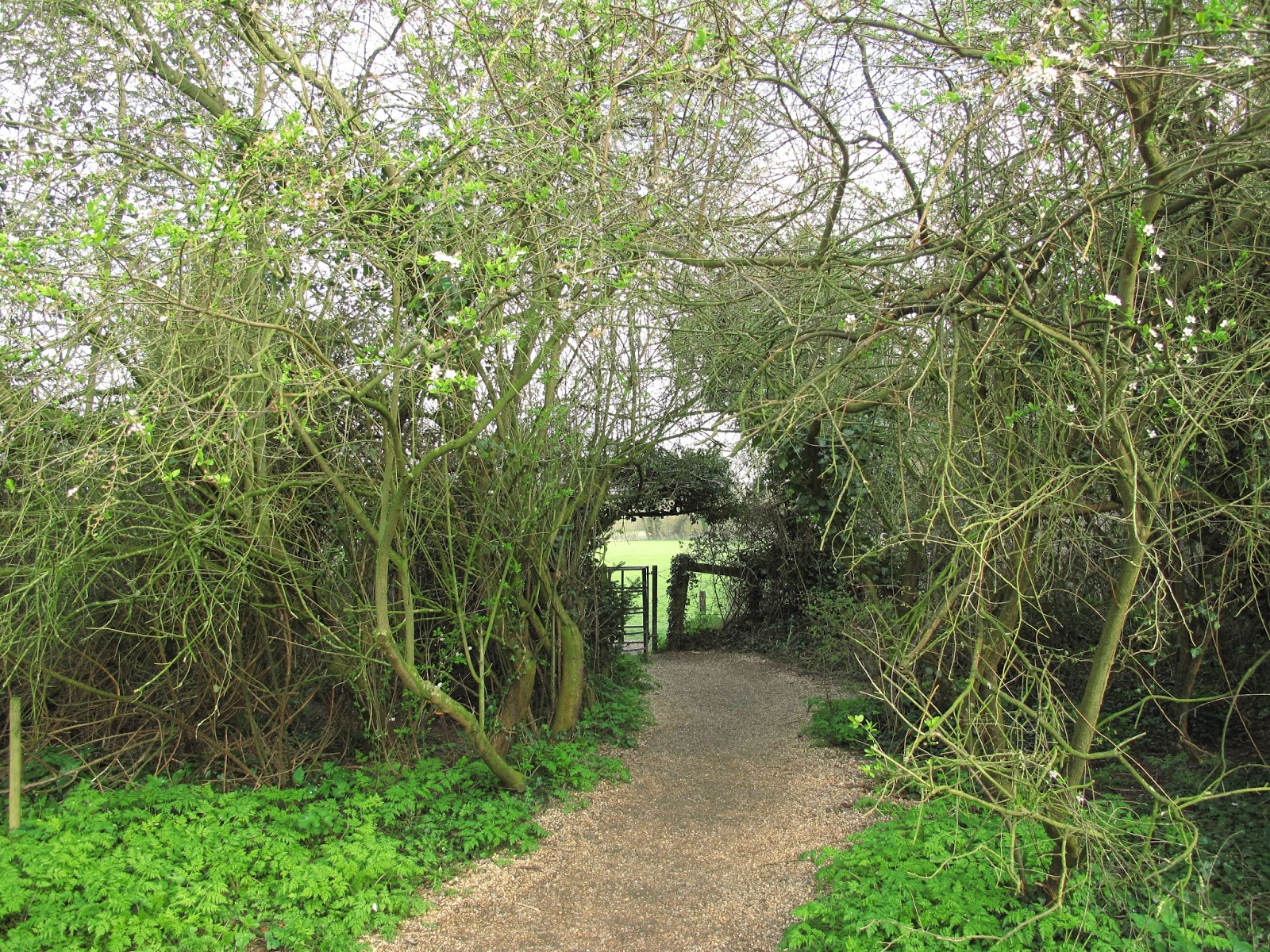
     There could hardly be a more peaceful piece of English countryside than the village of Grantchester. And the Tea Gardens is the most peaceful spot in the village. We wandered through the shady gate that's tucked away on one side of the Garden, that seems to beckon people to step through it and explore what's on the other side. After strolling over a lush green field we entered a small wood with a little winding path that leads to a branch of the river rolling lazily by.

The gate leading out of the Orchard Tea Gardens

The enchanting woods we wandered through in Grantchester.

The river in Grantchester.
     It was then time to get on to Cambridge if wanted to get there before the shops shut, so we made our way back through the Tea Gardens and along the quiet road to find our car. Just around the corner from the Tea Gardens is a lovely house with a statue of Rupert Brooke, the poet who in his college days used to frequent the orchard and the lawn chairs where he composed some lines about his memories there in his poem, "The Old Vicarage, Grantchester."

Stands the Church clock at ten to three
And is there honey still for tea? 

There is something fittingly and nostalgically poetic about Rupert Brooke, who had been a promising young student at Cambridge and spent time in this beautiful place, and then wrote this poem about his visits there while he was in Germany during World War I not long before he died in 1915. So I'm glad they are remembering him.


The statue of Rupert Brooke in Grantchester.
     After passing the pond and a few more fields we reached our car. We would have parked in the Orchard Tea Gardens parking lot, but there was some roadwork that prevented us going farther than the old church, so we parked along the street instead.

Grantchester's picturesque pond, complete with swans.
     Well, we spent so much time thoroughly enjoying ourselves in Grantchester that we only had time for a short jaunt back into Cambridge. Around 6:00 we drove straight into the city, using our hand-held map – a good investment – to find the central parking garage instead of the GPS. It was only £2 for 2 hours.

     We were in search of a pin for me to add to my backpack, but, of course, nearly every shop was shut except for one across the street from King's, and their pin was £4.50. I bought it anyway, since, as Mom pointed out, we came all that way to find one. :)

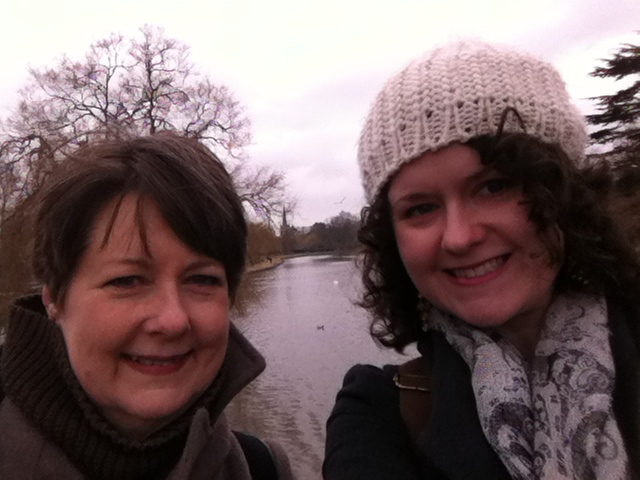
One of my favorite memories with Mom: coffee and conversation in front of King's College.
One of my favorite memories with Mom:
coffee and conversation in front of King's College.
     We then grabbed a large coffee from the Caffe Nero across from the college, and decided to sit on the low wall enclosing the front lawn to relax and enjoy our surroundings. We also enjoyed one of our many talks about English history and literature. This time we were contemplating the motivation for a people to follow their leader into war, from the Iraq war motivated by fear of terrorism, to Henry V's conversations with his troops in Shakespeare, who were compelled by force and fear to follow a monarch. (Yes, we do enjoy that sort of conversation...) :) It's hard not to have those in England, when history and literature are connected with nearly everything one sees.

     Then it was after sunset and time to return to Luton!


© Anna Morton 2016 

Friday, 5 February 2016

York the Magnificent

| The mighty York Minster |
| The mighty York Minster |

England Trip 2015
Saturday, March 28

(10:56 PM) I am greatly enjoying my chocolate malted bar recommended by our poet barista Josh at the Costa Coffee in York. :) He was pleasantly friendly, chatting with me while Mom was off, and we had the longest conversation that I've ever had with anyone besides Mom since we got here. There is something special about making human contact while you're traveling because you find you have things in common with people and you learn some insightful things that you didn't expect.

Our barista Josh made clear that he doesn't like the busy-ness of London, preferring the slower and friendlier way of life in the north – another northerner who loves his part of the country. :)

Then I discovered that he loves poetry – he actually loves sitting by the river and writing it himself! We do differ on what sort of poetry, as his favorites are '50s beat poets, but he also enjoys 18th century novels. :) It was discovering that I studied English literature that brought on the subject. Much of this conversation surprised me, I admit, because I guess I didn't expect to meet a young working man in York who loves literature – even though I should have known better than to have any such preconceptions! After all, I've seen 'North & South' about fifty times! Oh well, I'm glad to say that I was pleasantly surprised out of my prejudices, not unlike Miss Margaret Hale. ;)

That was at the end of our day in York, so I will now say something about the rest of it, starting with the beginning.

We took advantage of the Park and Ride from the outlets on the south side of York, which dropped us nearby to the city's center and most of it's famous sights.

The Shambles in York

We had splendid weather! More glorious sunshine passing in and out of the clouds, lighting up the Minster and the ruins of St. Mary's Abbey beautifully. The latter would have put Marianne Dashwood into raptures, it was so picturesque.

We walked through the famous Shambles first, which is also picturesque, but a tad touristy with its shops and tea rooms. (FYI: "The Shambles" is where a large chunk of Tudor buildings have been preserved.) Still, its Tudor architecture is worth seeing because it takes you back in time in an amazing way! The slightly off-kilter buildings lean into each other over the street just like on a postcard.

The Shambles in York

We found these fellows over a shop window.

Another view of the York Shambles

Another view of the York Shambles

As we left The Shambles from this street in the photo above we entered a sort of square where a weekly market was going on. There were lots of fun local vendors selling crafts, toys, a dangerous number of delicious desserts....

A market at York.
A market at York.
....and some deerstalker hats.

some deerstalker hats
How could I resist?
(Technically it was Mom's idea... Well, the collar bit was mine.)
We almost missed Molly's Tea Room because it is tucked away above an antique store. So when you follow the map to the spot you can't see it from the street. They had the most delicious looking cakes, so we had to have some after our pea soup and our cheese and chutney sandwiches. Another lovely touch was the lady charge calling everyone 'love' or 'darlin''. :) That never gets old!


Me with my lemon poppyseed cake and tea at Molly's Tea Rooms
Me with my lemon poppy seed cake and tea
at Molly's Tea Rooms
Mom with her coffee and walnut cake in Molly's Tea Room
Mom with her coffee and walnut cake
in Molly's Tea Room


Split pea soup with a sandwich.

We glimpsed York Minster (the famous and enormous church) and found a used bookshop with seven rooms of books around the corner... How we got out of there in fifteen minutes is mystery.

The Museum Gardens with the Abbey ruins is just down the street. (Everything in York is nicely close together. It was constantly surprising me.) It is a lovely park! There are Roman, Medieval and Tudor ruins, and it was lush and green with daffodils and tulips everywhere.

The Roman wall in the Museum Gardens.

St. Mary's Abbey ruins in the Museum Gardens, built in the 14th century and destroyed by Henry VIII in the 16th century.

St. Mary's Abbey ruins.
It's the epitome of a picturesque scene! (Picturesque in the 18th century romantic sense, that is.)
St. Mary's Abbey ruins.

St. Mary's Abbey ruins.
Proof that we were there. :)

We found the Minster again, and Mom thought we should try going in even though it was closed by then. But this time being a rebel paid off. We went in the open door and realized that it was 5:14, which meant that we got to stay inside and listen to the evensong service that was to begin at 5:15! We stood in the corner listening to the choir and we got to take pictures. A total win. (Unlike in Westminster Abbey where one is never allowed to take pictures.) It was filled with that glorious golden light, making the warm stone glow and the stained glass windows jump out from the walls in vivid color.

There it is: York Minster!

We'd heard of its reputation for being enormous, and boy did it live up to those. It's massive!
We'd heard of its reputation for being enormous, and boy did it live up to that. It's massive!

The nave (or whatever it's called... it's the main part of the building, anyway).

One of the stained glass windows above us.


Later we found the city wall, which gives a great view of York. That is another Roman remnant – they're everywhere! York almost feels like a history book with its variety of architecture from the Romans to the Normans to the medieval period to the Tudors to the present day. Mom and I just loved it!

The Roman wall around York. One of the most complete of its kind at over two miles long.

Climbing up on the wall gives you a fabulous view of the Minster.
It was nearly dark, so after stopping by Clifford's Tower (built by William the Conqueror in the 1080s), we caught the park and ride bus back to the Outlets, stopped by Sainsbury's, and made it home safely.

Another bastion of William the Conqueror: Clifford's Tower, right in the middle of York.


© 2016 Anna Morton


Thursday, 30 July 2015

Throwback Thursday: My first Regency Party

The very first of my Regency parties was a dinner I gave in honor of myself and my twenty-first birthday, and what an adventure that was! I acquired The Jane Austen Cookbook and got completely carried away delving into the Regency world, making as authentic a menu as my knowledge permitted, complete with soup, a first course, a second course, dessert and tea. It was thrilling! And complicated.

My family and friends are indulgent enough to go along with my historic reproduction fancies, and took part in the celebration and the dozen or so dishes of food with a very satisfactory enthusiasm. Some of them even dressed up with me. I am pretty blessed.

We re-decorated the house as nearly as possible to the Regency style, putting up paintings everywhere which had been painted by my talented grandmother, making silhouettes, laying out old books, putting out lace doilies and lighting candles everywhere. We even had a folding screen to cover up the TV - those come in very handy for hiding things.

I tried to do everything properly, including written invitations. Plus, I got to use my wax and seal to close them up. :)

Our dinner invitations.
It is a little daunting trying to acquire enough china, glasses and silverware for everyone and for every course, not to mention the napkins and chairs. But thanks to the collecting nature of our family and the kindness of my dear friends, I was able to collect enough bowls, salad plates, dinner plates, goblets, dinner forks, dessert forks, dessert bowls, dessert plates, soup spoons, knives, tea cups and saucers for fifteen people, and squeeze them into our dining room.

Our Regency table set for dinner.
The menu went like this:
  • We began with Swiss Soup Meagre, accompanied by Regent's Punch and Lady William's Muffins.
  • The first course contained a roast Turkey breast and Jaune Mange.
  • Followed by Jugged Steaks with Potatoes, Vegetable Pie, and A Receipt for Pudding, accompanied by sparkling Pomegranate juice.
  • Then came dessert: Ice cream, plums, tangerines, dried cranberries, toasted almonds and walnuts, with more Punch and Pomegranate juice.
  • Lastly, we had tea, which included Mrs. Perrot's Pound Cake, black and herbal teas, and coffee.

Our soup course with Regent's Punch.
I could not follow each recipe exactly, especially since not all of the ingredients are available in the U.S., but nearly all of them can be made! The Jane Austen Cookbook makes these recipes very accessible, converting the original eighteenth century instructions and measurements into the sort our modern minds can understand. This book is a must-have for everyone who wants to recreate Jane Austen's world in their kitchen or on their dining table.

Every recipe was a success, too! One of our friends who came is still raving about the Vegetable Pie, and the Pound Cake recipe is one I continue use for even ordinary occasions.

The Soup is a cream-based recipe with greens, cucumbers, onions and herbs - a rather different sort of soup than 21st-century Americans are used to, but one which was enjoyed by each of us at the party, all the same. The Jaune Mange is a sort of orange-flavored gelatin poured in a mold. The pudding was fun to make because it is based on a poem written by Mrs. Austen. It's basically a bread pudding with currants, which give it a nice, subtle tartness.

If the Vicar you treat,
You must give him to eat,
A pudding to hit his affection;
And to make his repast
By the canon of taste,
Be the present receipt your direction. 
...
A Receipt for a Pudding, by Mrs. Austen 

The rest of the recipes are pretty self-expalantory. I attempted to build a pyramid with the fruit... I employed toothpicks to position the fruit, which barely worked, making my structure a bit unstable. It would have been more successful, I suppose, if I had made some sort of cone to put in the middle. But I didn't, and relied on the stability of a couple dozen round objects stacked upon each other. I wouldn't recommend this method if you want any peace of mind while watching it on the table, but I believe that it worked well enough for a first attempt. 
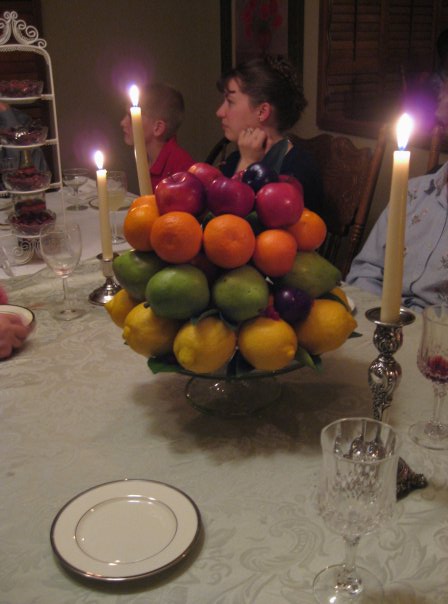
My attempt at a fruit pyramid...

The tea things were arranged in the "drawing room" (a.k.a. our living room), where I had wheeled in a round table (an unfamiliar object in our living room, unfortunately). After finishing dessert at the dining room table we did things properly by having the ladies withdraw into the drawing room while the men remained to talk about things like hunting and farming (or things like that). Once the men rejoined us, we gathered into three teams to play one of the Austen family's favorite parlor games. Each team is given the same group of several words, and must compose a poem that includes every one of those words. Our words were: flamingo, piano, pink, beach and twenty one (the theme of the words was about me...). I have the brilliant result of one team that I can now share:

Twenty pink flamingos standing on one leg each,
One lonely flamingo walking along the beach.
Twenty one hermit crabs dragging a piano from the sea,
The flamingos looking on with great curiosity!
One flamingo playing with intensity,
Twenty flamingos singing with great jubilee!

It was certainly entertaining hearing each of the results! So I can imagine how much fun the Austen family must have had, witty as they all were, sitting around in the evenings and laughing hysterically at each others' humorous creations. Oh, how I would love to have seen that!
A few of us young ladies graced the company with some performances on the piano, and we had a reading of one of Jane Austen's written prayers that my cousin kindly agreed to recite for us. It was night of suitably refined and edifying entertainment.

Above all other blessings Oh! God, for ourselves, and our fellow-creatures, we implore Thee to quicken our sense of thy Mercy in the redemption of the World, of the Value of that Holy Religion in which we have been brought up, that we may not, by our own neglect, throw away the salvation thou hast given us, nor be Christians only in name. Hear us Almighty God, for His sake who has redeemed us, and taught us thus to pray.
An Evening Prayer, by Jane Austen
Playing 'My Father's Favorite' :)
I opened some birthday gifts, and then it was time for tea, which meant the evening was coming to a close. But before we all completely dispersed, there were a few of us that were still up for dancing! So I turned on a YouTube video of 'Northanger Abbey' and we all attempted to imitate Henry and Catherine in the assembly rooms. My cousin and I had watched a few of the dancing scenes from the movies over and over and over again to figure out what in the world they were doing, which helped, but there are inevitably many moments of confusion and even more of laughter when a group of people are attempting to learn one of these dances... But we were having at least as much fun as it looks like Henrietta and Louisa are having during their impromptu dance in the 1995 adaptation of 'Persuasion'. :)
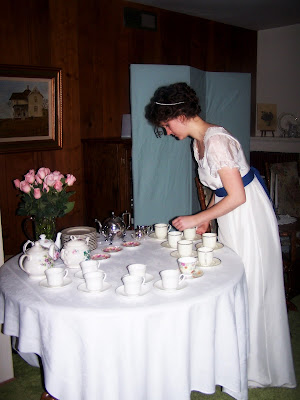
Our tea table.
Our tea table.

Then it was time to return to the twenty-first century. That is never something I look forward to... Mostly because it means we have to clean up the monstrous mess in our kitchen. But it also makes me sad to leave a moment that seems closer to that amazing time in history than any moment  that I have had in my life before.

This experience definitely made me appreciate the need for household staff to smoothly pull off such an operation. What I would have given for a cook and a couple of maids! No one minded that I had to leave the room to bring in more food over and over again, causing long interruptions in between courses, and neither did I, but only because it was a new experience and we wouldn't know the difference. I'm sure Mrs. Norris would have been appalled...


Pretending to be back in time... Can I just live this way?


Tuesday, 28 July 2015

Going Downtown, Elizabethan Style | Stratford-upon-Avon, Part 3

 
Even though it was cloudy and COLD, the view down the Avon was still lovely.

2015 England Trip Travel Journal Entry
Saturday, March 14

(2:20 PM) It was a sad thing to leave Stratford. One really needs to spend two nights there to fit everything in (including shopping in their numerous boutiques and charity shops). We dragged ourselves out of bed at 7:30 and we got straight out onto the High Street, but Hathaway Tea Rooms didn't open until 10:00, so we walked over to the river.

A couple of the old bridges on the Avon.

The main footbridge over the Avon in Stratford, complete with white swan.

The theater of the Royal Shakespeare Company.

There were rather a lot of swans, adding to the picturesque view of Holy Trinity Church in the distance.

Me and the theater of the RSC. And a houseboat!
Proof that we were both there. :)


The Avon is quite picturesque, with dozens of swans sailing about, old bridges, cheerfully painted houseboats and Holy Trinity Church in the distance.

The famous Shakespeare monument on the banks of the Avon.

Poor Hamlet... (His statue represents tragedy.)
No thanks, Hal. Remember,  uneasy lies the head that wears the crown.  (Hal represents the history plays.)
No thanks, Hal. Remember,
uneasy lies the head that wears the crown.
(Hal represents the history plays.)


And the weather was chilling... Oh, was it chilling! So it was quite pleasant to sit down to breakfast in Hathaway Tea Rooms. We were alone for a bit, so we talked a little with the hostess, who turned out to be from New Zealand. We asked her about buses to Mary Arden's Farm, and there are some that do depart/stop at the main bridge, she said, but we later found out that the only bus running on Sundays is the hop-on-hop-off tour bus. That helped us decide to stay in town to see Shakespeare's grave at Holy Trinity Church, Hall's Croft and Harvard House.

One of Stratford's main streets. Hathaway Tea Rooms is in the middle section of those half-timbered buildings.

Looking out at Harvard House from Hathaway Tea Rooms.

Another one of Stratford's picturesque streets.

At the far left end is St. Edward's school where Shakespeare himself attended. The rest are just houses. Yes, people live there!


We had a pleasant walk along the river to find the church, taking a sort of nature path through some small park areas where people were playing with their dogs and past a couple of old buildings where the path was shaded by overhanging trees. There were many people out walking or on the river or sitting on benches perched by the bank. The sun was peaking out a little by then, even though it still felt cold, but I still think the people on the river must be slightly crazy. The church wasn't far, and it was easy to find, as one would think, seeing as it is rather famous. What wasn't easy to find was Shakespeare's grave - at least if you base your search on assumptions like we did. We walked all the way around the building, looking for at least one headstone in the graveyard that looked even slightly different from the others. Certainly, we thought, there would be something to make it clear where one of the most famous people in the world is buried... We even asked a couple people who live in Stratford, and they didn't know where he was, either! Feeling at a loss, we finally just went inside. If we had simply done that to begin with we would have saved ourselves a bit of trouble. He is buried inside, of course. At the front of the church!

The inside of Holy Trinity Church.

The great man himself lies here...
'Good friend for Jesus sake forbeare,
To dig the dust enclosed here.
Blest be the man that spares these stones,
And cursed be he that moves my bones.'

He is buried next to his wife, son-in-law and grandsons-in-law. They are very simple engraved stones on the floor. Every part of the church building would have been there in his time, since it dates from the 1200s to the 1400s.


Happily, just down the road is Hall's Croft, the home of Shakespeare's oldest daughter Susannah and her husband Dr. John Hall. It is Jacobean, built in 1613, and still has it's original flooring. These Tudor and Jacobean houses have something less refined about them than Georgian, so it is hard to conceive how Shakespeare, being such a master of language as he was, as well as being considered as possibly the most skilled user of the English language, ever, could have become so, coming from such a rural, limited society. Of course, he must have been a genius, but it is certainly intriguing to know how much of his talent simply must have come from his natural gift.

Hall's Croft, another beautifully preserved half-timbered building.

The dining room of the house. It is the sort that would have belonged to a well-to-do Jacobean family.

Susannah's husband was a doctor, and this would have been his surgery, or consulting room.

And the kitchen! A very important room.

Part of their spacious back garden.


Harvard House belonged to the family that Harvard University is named after. (Isn't that a surprise...) We popped into a few shops before heading out to the train station, but there wasn't much time for shopping, so Mom grabbed some coffee, quiche and a chocolate cornflake bar at a little bakery called Havilands for the train ride.


New Place, Shakespeare's last home. It's being renovated, so it wasn't open during our visit to Stratford.
 
Logistics: 
  1. The train to London (Marylebone Station)
  2. The Tube from Marylebone to Charing Cross Station on the Bakerloo Line
  3. Continuing on the Tube from Charing Cross Station to Stockwell Station on the Northern Line
  4. Continuing on the Tube from Stockwell Station to Brixton Station on the Victoria Line


© 2015 Anna Morton