Tuesday, 28 July 2015

Going Downtown, Elizabethan Style | Stratford-upon-Avon, Part 3

 
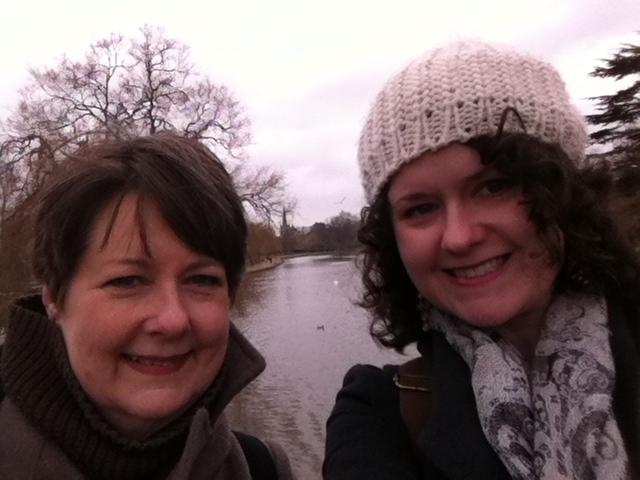
Even though it was cloudy and COLD, the view down the Avon was still lovely.

2015 England Trip Travel Journal Entry
Saturday, March 14

(2:20 PM) It was a sad thing to leave Stratford. One really needs to spend two nights there to fit everything in (including shopping in their numerous boutiques and charity shops). We dragged ourselves out of bed at 7:30 and we got straight out onto the High Street, but Hathaway Tea Rooms didn't open until 10:00, so we walked over to the river.

A couple of the old bridges on the Avon.

The main footbridge over the Avon in Stratford, complete with white swan.

The theater of the Royal Shakespeare Company.

There were rather a lot of swans, adding to the picturesque view of Holy Trinity Church in the distance.

Me and the theater of the RSC. And a houseboat!
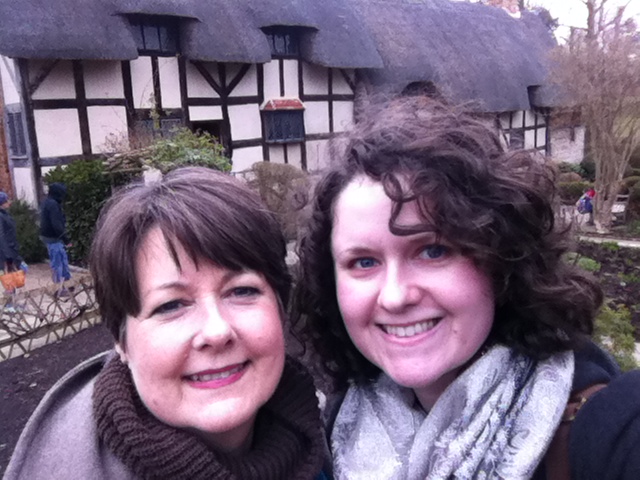
Proof that we were both there. :)


The Avon is quite picturesque, with dozens of swans sailing about, old bridges, cheerfully painted houseboats and Holy Trinity Church in the distance.

The famous Shakespeare monument on the banks of the Avon.

Poor Hamlet... (His statue represents tragedy.)
No thanks, Hal. Remember,  uneasy lies the head that wears the crown.  (Hal represents the history plays.)
No thanks, Hal. Remember,
uneasy lies the head that wears the crown.
(Hal represents the history plays.)


And the weather was chilling... Oh, was it chilling! So it was quite pleasant to sit down to breakfast in Hathaway Tea Rooms. We were alone for a bit, so we talked a little with the hostess, who turned out to be from New Zealand. We asked her about buses to Mary Arden's Farm, and there are some that do depart/stop at the main bridge, she said, but we later found out that the only bus running on Sundays is the hop-on-hop-off tour bus. That helped us decide to stay in town to see Shakespeare's grave at Holy Trinity Church, Hall's Croft and Harvard House.

One of Stratford's main streets. Hathaway Tea Rooms is in the middle section of those half-timbered buildings.

Looking out at Harvard House from Hathaway Tea Rooms.

Another one of Stratford's picturesque streets.

At the far left end is St. Edward's school where Shakespeare himself attended. The rest are just houses. Yes, people live there!


We had a pleasant walk along the river to find the church, taking a sort of nature path through some small park areas where people were playing with their dogs and past a couple of old buildings where the path was shaded by overhanging trees. There were many people out walking or on the river or sitting on benches perched by the bank. The sun was peaking out a little by then, even though it still felt cold, but I still think the people on the river must be slightly crazy. The church wasn't far, and it was easy to find, as one would think, seeing as it is rather famous. What wasn't easy to find was Shakespeare's grave - at least if you base your search on assumptions like we did. We walked all the way around the building, looking for at least one headstone in the graveyard that looked even slightly different from the others. Certainly, we thought, there would be something to make it clear where one of the most famous people in the world is buried... We even asked a couple people who live in Stratford, and they didn't know where he was, either! Feeling at a loss, we finally just went inside. If we had simply done that to begin with we would have saved ourselves a bit of trouble. He is buried inside, of course. At the front of the church!

The inside of Holy Trinity Church.

The great man himself lies here...
'Good friend for Jesus sake forbeare,
To dig the dust enclosed here.
Blest be the man that spares these stones,
And cursed be he that moves my bones.'

He is buried next to his wife, son-in-law and grandsons-in-law. They are very simple engraved stones on the floor. Every part of the church building would have been there in his time, since it dates from the 1200s to the 1400s.


Happily, just down the road is Hall's Croft, the home of Shakespeare's oldest daughter Susannah and her husband Dr. John Hall. It is Jacobean, built in 1613, and still has it's original flooring. These Tudor and Jacobean houses have something less refined about them than Georgian, so it is hard to conceive how Shakespeare, being such a master of language as he was, as well as being considered as possibly the most skilled user of the English language, ever, could have become so, coming from such a rural, limited society. Of course, he must have been a genius, but it is certainly intriguing to know how much of his talent simply must have come from his natural gift.

Hall's Croft, another beautifully preserved half-timbered building.

The dining room of the house. It is the sort that would have belonged to a well-to-do Jacobean family.

Susannah's husband was a doctor, and this would have been his surgery, or consulting room.

And the kitchen! A very important room.

Part of their spacious back garden.


Harvard House belonged to the family that Harvard University is named after. (Isn't that a surprise...) We popped into a few shops before heading out to the train station, but there wasn't much time for shopping, so Mom grabbed some coffee, quiche and a chocolate cornflake bar at a little bakery called Havilands for the train ride.


New Place, Shakespeare's last home. It's being renovated, so it wasn't open during our visit to Stratford.
 
Logistics: 
  1. The train to London (Marylebone Station)
  2. The Tube from Marylebone to Charing Cross Station on the Bakerloo Line
  3. Continuing on the Tube from Charing Cross Station to Stockwell Station on the Northern Line
  4. Continuing on the Tube from Stockwell Station to Brixton Station on the Victoria Line


© 2015 Anna Morton
  

Tuesday, 21 July 2015

Much Ado About Nothing | Stratford-upon-Avon, Part 2

| Or, as this production by the Royal Shakespeare Company was called: Love's Labour's Won |

  • Here are my travel journal notes after seeing the performance on March 14.

A Poster in Marelybone Station: Edward Bennett as Benedick  and Michelle Terry as Beatrice.
A Poster in Marelybone Station: Edward Bennett as Benedick
and Michelle Terry as Beatrice.
 Now I shall wax eloquent on the play and my opinions of it. First, the acting. It dawned on me that Much Ado About Nothing is very much an ensemble performance. I've always considered Beatrice and Benedick to be the stars, and they could be given that title in this play, but they are not starring roles in the same way that a Hamlet or a Rosalind is. A majority of the story is about Hero and Claudio, even though those two characters don't say comparatively much. I think it is just that Beatrice and Benedick are just so un-missable and entertaining that they overwhelm one's memory after watching the play, and you come away being more delighted with those two than with all the rest. That is simply in the power of the roles themselves, and no matter who plays the parts they would make that impression.

 Having said all that I cannot deny that Michelle Terry and Edward Bennett brought these roles to life with fiery energy! She was simply bursting with it! She ran, she danced, she sobbed, and every line was as full of different tones, volumes and rhythms as a symphony. You never knew what was coming!


I wonder that you will still be talking, Signior Benedick, nobody marks you.

What, my dear Lady Disdain! Are you yet living? 

Is it possible disdain should die while she hath such meet food to feed it as Signior Benedick?
Courtesy itself must convert to disdain if you come in her presence.

Then is courtesy a turncoat. But it is certain I am loved of all ladies, only you excepted;
and I would I could find it in my heart that I had not a hard heart, for truly, I love none.

A dear happiness to women. They would else have been troubled by a pernicious suitor.
I thank God and my cold blood I am of your humor for that. I would rather hear my dog
bark at a crow than a man swear he loves me.

God keep your ladyship still in that mind, so that some gentleman or other shall 'scape a
predestinate scratched face.

Scratching could not make it worse an 'twere such a face as yours were.

That contrasted with him delivering his lines in a quick, snappy and getting-the-last-word-in style. Although his face could be as energetic as her running about, and his well timed pauses accompanied by a very expressive look always set the audience laughing. The best one was when he was reading his attempt at a romantic poetic composition. He read the first two lines quite undramatically, which itself made the audience laugh.

The god of love
Who sits above...

But then he stopped and gave us such a scorching look that we laughed even harder. And of course his holding the look longer only made things worse...
And knows me, and knows me,
How pitiful I deserve --

One of the show's best scenes was Benedick overhearing Don Pedro, Claudio and Leonato talking of Beatrice's "love" for him - from the time he enters to his exit it may have been the best. He hid behind the curtains, the Christmas tree, in the tree, and poked out his head at the most hilarious moments - or, as he did once, began walking out. The climax was the toast to close the conference, and Benedick stuck his hand out with a glass in it from inside the tree and Leonato filled it without blinking an eye. Then, once alone, he emerges from the tree all disheveled and covered in pine needles, with an ornament hanging from his head, and says in the most touching way that her love "must be requited" - as if hearing of her love is deep down what he has always hoped for, and now he is free to release his own love for her that he has had pent up in his own heart.

Love me? Why, it must be requited. I hear how I am censured. They say I will bear myself proudly
if I see the love come from her. They say, too, that she will rather die than give any sign of affection.
I never did think to marry.

Both of them made their love for each other very touching, as if they were willing to become vulernable to each other once they were aware of the other's love. So sweet!

You have stayed me in a happy hour. I was about to protest I loved you.

And do it with all thy heart.

I love you with so much of my heart that none is left to protest.

Every actor was good, and one I always looked forward to seeing on the stage was Claudio. He brought a lot of subtle emotion to what could be a two-dimensional character. When he began to cry at Hero's 'tomb' tears came to my eyes, too.

Done to death by slanderous tongues
Was the Hero that here lies.
Death, in guerdon of her wrongs,
Gives her fame which never dies.
So the life that died with shame
Lives in death with glorious fame.
 Done to death by slanderous tongues
Was the Hero that here lies.
Death, in guerdon of her wrongs
Gives her fame that never dies.
So the life that died with shame
Lives in death with glorious fame.

The inquest with Dogberry made Mom and I laugh til tears were poring down our cheeks and I could barely breathe! It was supposed to be a tiny room, so when the sexton was attempting to leave by walking around the table there was no room around Dogberry. So they all lifted up the table to turn it, but all they really ended up doing was turning all the way around to exactly where it (and they) started, and the sexton still couldn't get out.

Master constable, let these men be bound and brought to Leonato's. 
I will go before and show him these examinations.

Come, let them be opinioned. 

The RSC stage set for the first scene!

The sets were stunning! One part was a floor and a back wall that both slid all the way to the back of the stage, revealing another floor with a great square in the center that would change by sinking down one floor and then raising up another with varying sets on it from underneath the stage, such as a grassy lawn, the sexton's quarters or Hero's dressing table. 

The costumes were excellent, very 1918. We were seated along the wall on the ground level, and next time I'd prefer to be closer to get a sharper view of their faces, but we did have a nice and almost straight forward view.

We're ready! And the performance exceeded my expectations. Brilliant!

Thursday, 16 July 2015

Visiting the land of the Bard | Stratford-upon-Avon! Part 1

 
The home of the Hathaway family, Shakespeare's in-laws. It is known today as Anne Hathaway's Cottage.

2015 England Trip Travel Journal Entry

Saturday, March 14

Logistics: 

Marylebone selfie!
Marylebone selfie!
  1. The Tube from Stockwell Station to Charing Cross Station on the Northern Line 
  2. Continuing on the Tube from Charing Cross Station to Marylebone Station on the Bakerloo Line
  3. The train to Stratford-upon-Avon

(10:40 AM) Staying up late last night was worth it since we only had 40 minutes to get out of the door. Pre-making breakfast was a life saver... We certainly made it in exact time to Marylebone Station - in time to get a coffee and not to have to run to the train. And even get a selfie! :)

I was afraid I would regret leaving London, even for a day, but now going to the country truly sounds refreshing. London is tiring, especially when you're out and about all day, surrounded by crowds, cars, noise and just a busy working world. It may not be so exhausting  just living there, not trying to pack so much into every day, but I'm now not sure if I would enjoy living in London as
much as I thought. We'll see.


Spending a few moments admiring Marylebone Station and getting excited by the poster of the play we are going to see!
The home of the Shakespeare family in 1564 when Will was born.
(1:25 PM) We have quite a lovely view for lunch: Shakespeare's birthplace. :) We're staying warm in their cafe next door, pulling out our own lunch and drinking their warming liquids (tea and coffee, of course), for it is bone-chillingly cold outside - at least to a Cali girl like me.


"Be large in mirth. Anon we'll drink a measure \ The table round." And we were drinking our tea very mirthfully. ;)

"I would I were at home." (As You Like It) But at Shakespeare's home. :)
"I would I were at home." But at Shakespeare's home. :)

"When daffodils begin to peer..." in the garden of Shakespeare's Birthplace.
The original part of the house with the glove-making shop and kitchen downstairs, and bedrooms upstairs.


This was added a bit later, and Shakespeare lived her a while with his wife and family.


(11:43 PM) It was too short! It felt like there was not way the play could be over already, even though they said seemingly every line. It's just a mark of a well-done performance, I guess. What a Shakespearean day we have had! His birthplace, the Hathaways' cottage, the RSC - and every one of them with a shop bursting from all the Shakespeare memorabilia. And objects with quotes are my one weakness...

We had a sweet guide for the birthplace - once we got in with our 2-for-the-price-of-one deal thanks to some very nice and helpful workers behind the ticket desk. My "passport" for a free 5-house pass on my Shakespeare app apparently couldn't be used with an online ticket (which we had already bought). But they finagled something and gave us the deal anyway. :)

The kitchen of the Shakespeare's home.


The Shakespeare boys' room: William, Gilbert, Edmund and Richard. They got the fireplace.
 We found an alternate route to Anne Hathaway's cottage after being redirected by a nice mom out walking with her baby. It's just cutting through Stratford-upon-Avon College and a neighborhood, then you're simply directed by many convenient signs. What a lovely place it was!
The Hathaway cottage.

Twenty years ago Mom and I stood in front of the replica built near Victoria, British Columbia. Special times! :)
The kitchen in the Cottage.

"Suffer love? A good epithet." :)

The garden, orchard and forest walk were particularly pleasant, especially once the sun came out, giving everything a golden glow! We took a rather confusing way back to the town center, but we at last got to our B&B to deposit our extra gear. Then we were off to the theater!
The Woodland Walk at the Cottage. It felt like being in the Forest of Arden.
The Woodland Walk. It felt like being in the Forest of Arden.
"Daffodils, / That come before the swallow dares, and take / The winds of March with beauty;"

At the Hathaways' Cottage


Our first steak and kidney pudding. Definitely recommend.
Well, we had to find somewhere to eat among the numerous pubs, first. Around the corner from the theater is The Golden Bee, and they have a brilliant deal of two entrees for nine pounds. We both got steak and kidney pudding with peas, chips and gravy, which arrived very quickly. Mom had gone to ask if it would arrive soon, and it came once she had left. :) It was scrumptious! British food at its best.


Next time: the play... 


© 2015 Anna Morton

Monday, 13 July 2015

Historic Clothing in the Victoria and Albert Museum

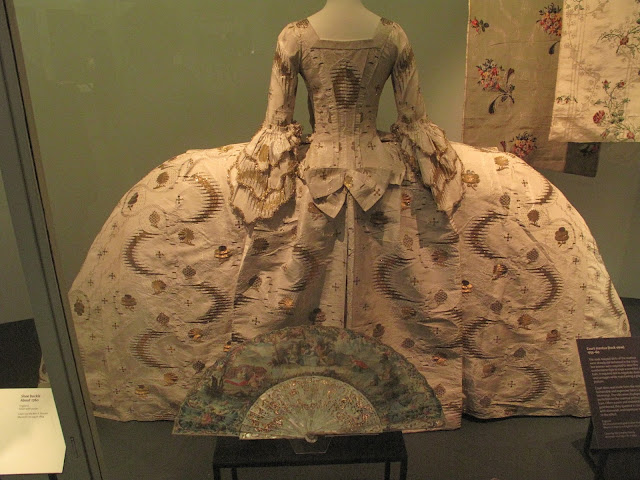
Mid-18th century "Court Dress"

Here are more pictures of my favorite pieces in the fashion gallery of the Victoria and Albert Museum. (I apologize in advance for all the reflections in the glass - but unfortunately it was impossible to avoid them entirely.)

To be around actual clothing worn by actual people from the past gives me the most incredible feeling. It is the past preserved - a little piece of history that as I stand before it opens up an entire world. Knowing it belonged to a person who was just as human as I am, who wore this piece of clothing as they were living their life, interacting with their family and friends, walking on the streets where they lived and drinking tea in their homes drops me into their life for a moment. To me this is what is so special about a mannequin in a museum with some clothes on it.

Now I am done with my rhapsodizing and philosophizing: on to the clothes! The photo above was oldest piece, dating from the mid-18th century. It is "court dress," which, as you might guess, is what was worn in the royal court. It was even more than the popular style, it was required. I don't know what they did if you failed to meet the requirements, but I suppose they simply didn't let you in. It isn't very practical, but you must admit that it makes a statement!

The gallery was arranged chronologically, so the next piece is from a bit later in the 18th century. This blue damask gown has lots of that gathered trim that I like so well. There is something so distinctly Georgian about it, too.

A Georgian gown, circa 1760s.
Ah, the robe a la polonnaise! Possibly my favorite historic fashion. This was the fashion of Jane Austen's parents, George and Cassandra. It has cleaner lines and a more classic shape than earlier Georgian styles, adding to its elegance and practicality, and giving it a more timeless style than the oversized skirts and plethora of ruffles and trims that preceded it.

Robe a la Polonnaise, circa the 1770s and 1780s.

The typical Polonnaise skirt that can be looped up, as it is here, or left to hang straight.
Even the underpinnings are a work of art in the 18th century! I knew this, as I have attempted my own, but I was impressed by just how tiny everything was. There were dozens of boning channels, and the armhole was lined with what looked like leather, which I think is rather a marvelous idea, since that part of the garment would have a lot of wear and tear.
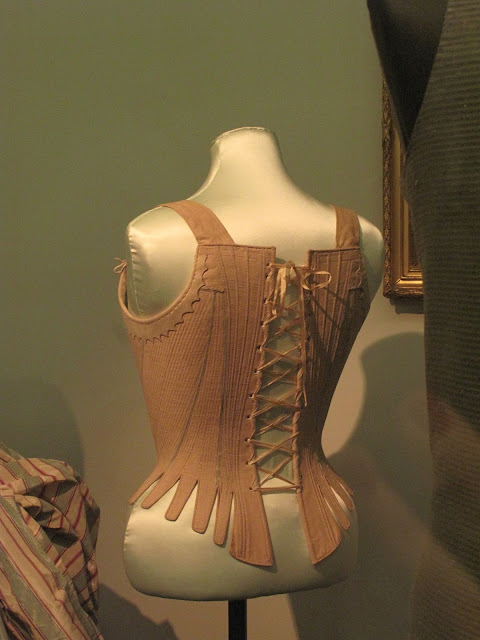
The work of art that is a set of 18th century stays.


 Here is a most familiar style. If you have seen 'Pride and Prejudice,' you know when we are: the unique and fabulous Regency! Practical, elegant and with a most distinct style, the dresses of the Regency were a result of a sort of revolution in fashion, discarding the more restrictive shapes of the Georgians in favor of more natural (think: Rousseau) shapes. I think women, once they got over the shock, must have rejoiced at the freedom of movement they could achieve in this new fashion. :)

The first dress in the gallery is a day dress of the middle Regency, with a straighter skirt than those of the earlier Regency, and a practical print. Jane Austen may have worn a dress like this when she lived at Chawton Cottage in 1810.
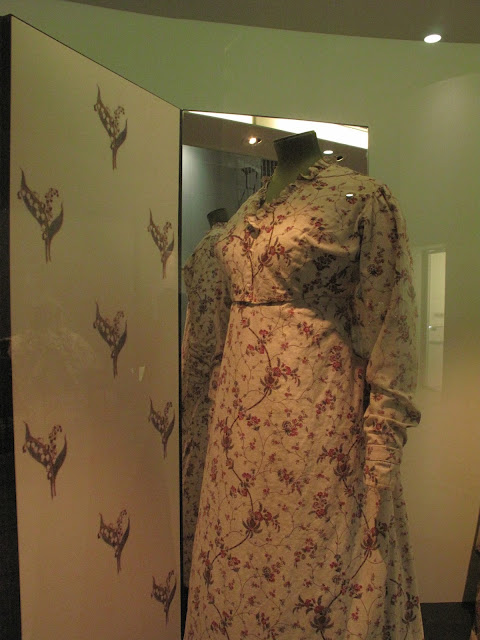
A middle Regency printed day dress.

More of the day dress.

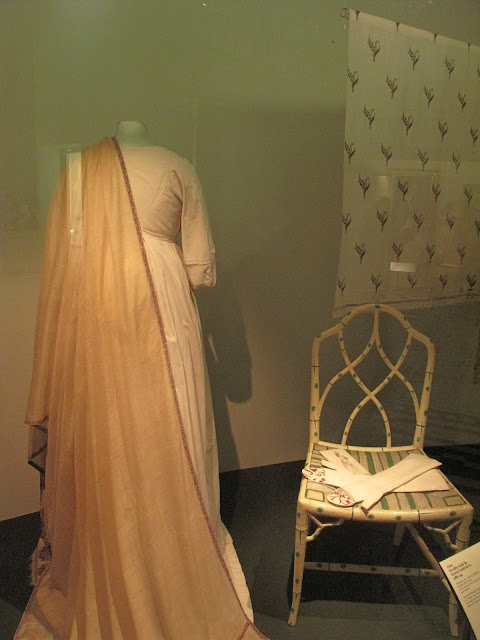
 This is an early Regency style, with a closer resemblance to the portrait dress of the 1790s in its fuller skirt. It was difficult to see or get a shot of the front, but I believe it is a crossover gown made in a simple white muslin.
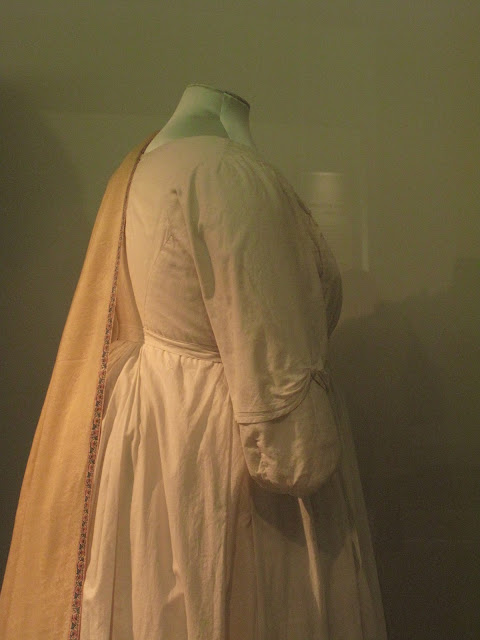
An early Regency crossover gown.

This early Regency gown illustrates the long classical silhouette of the era.


 This gown illustrates the transition from the Regency to the Romantic style, with the waist being lower and the sleeves larger. It was a spectacular piece! The detail was mesmerizing. I could tell this would have belonged to a very wealthy young lady because of the sheer amount of expensive trim. :) All of that intricate lace and gold work all over the entire dress would have cost a fortune.
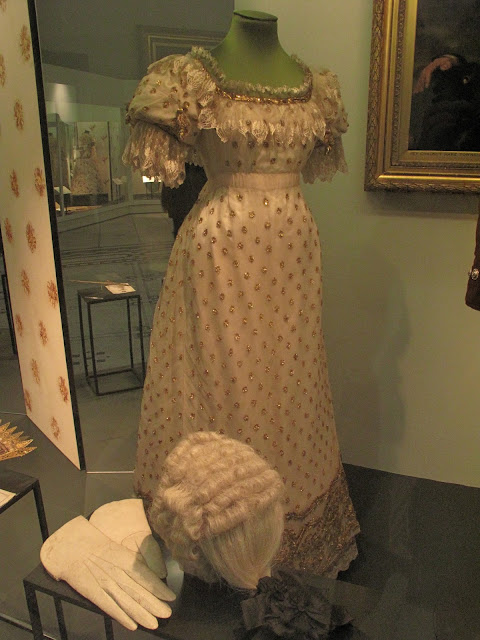
A dress circa 1820 transitioning between the Regency and Romantic styles.
Oh, the detail!
Oh, the detail!
A walking dress from the same period. Another point of transition that can be seen in this dress is in the line of the skirt, especially in the hemline. It doesn't just hang from the waistline, there are corded petticoats and techniques used to stiffen the hem so that it has a more unchangeable A-line shape, hanging rather like a bell when the person wearing it is walking.
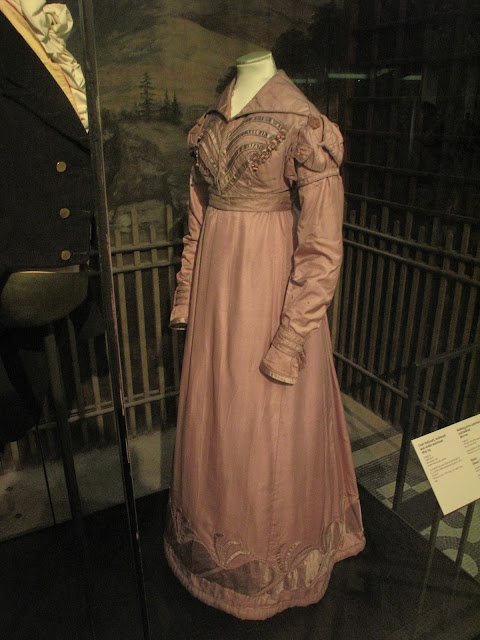
A walking dress, circa 1820.


 And now we come to the fully-fledged Romantic fashions! The sleeves make this unmistakable. The style went back to the natural waist, accentuated by more petticoats (and the big sleeves).

Dresses from the Romantic era, circa 1830s.
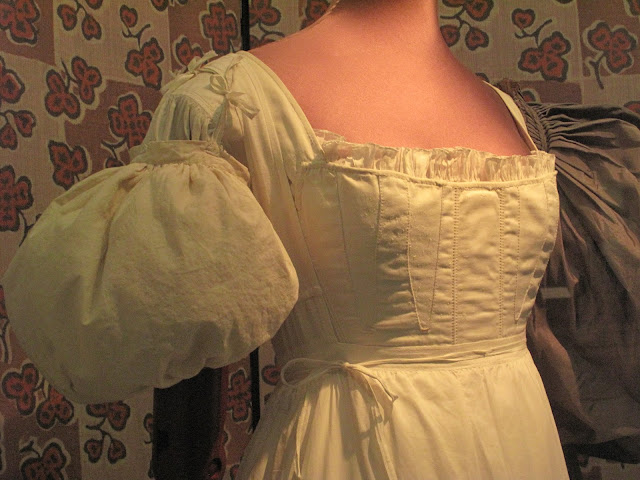
A more perfect example of Romantic underpinnings may be impossible to find in this day and age. Upon first seeing this I may have been more excited than I would now care to admit... But it reveals all of the secrets to the silhouette of the Romantic era! The sleeve pads, the stays, the corded petticoat - now it all makes sense. Especially the sleeve pads. It seems almost ingeniously simple, now, but for a long time I wondered how they successfully kept those enormous sleeves puffed.

Secrets revealed: the underpinnings of Romantic era fashion.

I had to get a close-up.

Next in the gallery was the fully-fledged Victorian era with its tiny waists and big skirts. I am by no means an expert in Victorian fashion, so I cannot regale you all with its style details or particularly distinctive elements. I have only seen some period dramas that had these exact same styles in them. For example: this next dress looks almost identical to a dress Margaret Hale wears in the BBC adaptation of 'North & South' (except hers is a print and no skirt ruffles). I have always thought it was a lovely style, so to see an original dress in that same style and in person was quite exciting. :) It was a wedding dress and made out of a fine, thin muslin.

An early mid-Victorian gown, circa 1850.

An early mid-Victorian gown, circa 1850.

This one was rather eye-catching... It is quite a fabulous color! This is mid-Victorian, worn in 1869-70, and style has moved on to the hoop skirt. A person can tell that the next style will be the bustle by looking at how the skirt is made. I personally think this style is a bit more elegant than a bustle, but we won't get into that. :) I think hoop skirts would be rather awkward to wear, too, actually. But those were the styles!

Mid-Victorian gown, circa 1870.
If you have seen 'Lark Rise to Candleford' you will understand when I say that this ensemble reminds me so much of Dorcas Lane. It must be from exactly the same era, the late Victorian - probably the early 1890s.
Late Victorian - probably the early 1890s
Historic fashion: "It's my one weakness."
Here is an ensemble from the elegant and opulent Edwardian era. This skirt and blouse were worn in 1910-12, just before the Titanic sank and the drama of 'Downton Abbey' begins.

Edwardian ensemble, circa 1910-12

I thought this dress and this hat were two of the most elegant pieces in the gallery. That gown has such exquisite work on the thinnest  of thin white muslins, draping so gracefully. This is another piece in the Edwardian section of the gallery.

I think that hat belongs at the Ascot races in 'My Fair Lady.' :)

Edwardian evening dress and hat.
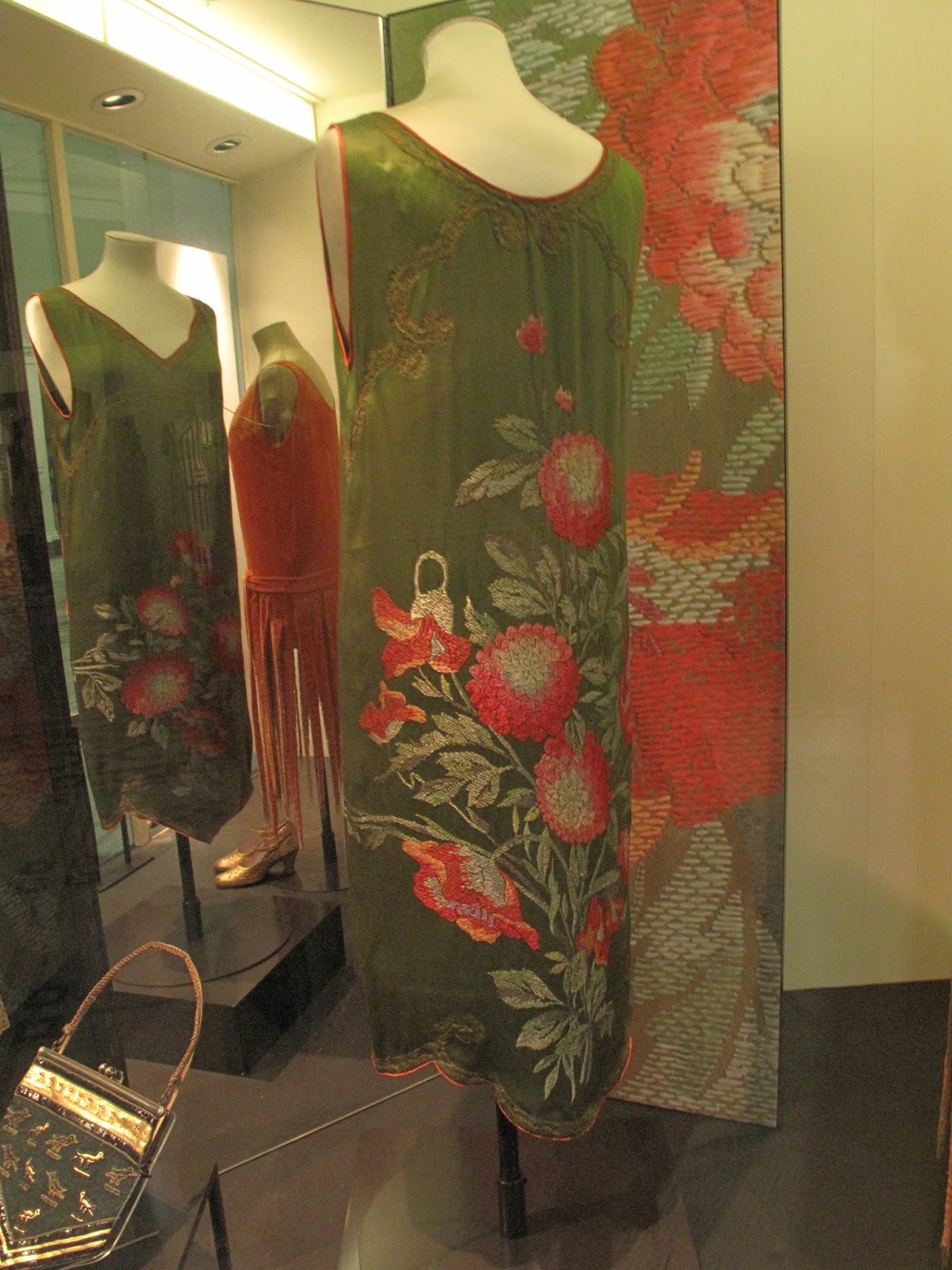
The roaring 20s! I don't need to point out the distinctive elements of this style or how it changed from the decade before. The biggest change may be the lack of material below the hemline... It reminds me of something Lady Edith Crawley might wear. She does seem to favor green and coral shades.
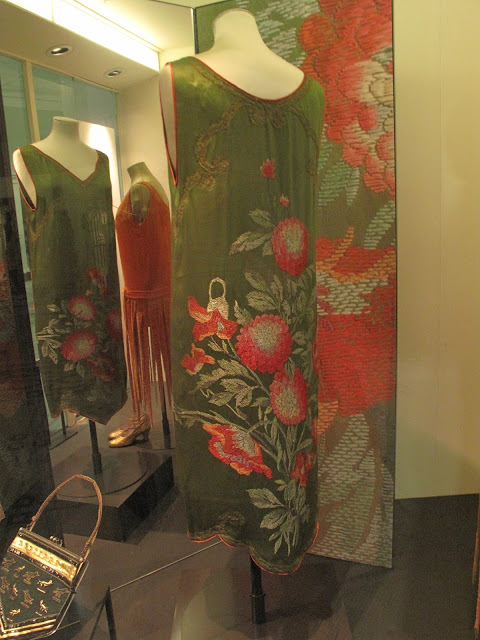
A dress of the roaring 1920s.
Now we're into the 1940s and the somewhat more conservative wartime styles with straighter skirts and squarer shoulders.

Fashion during WWII
Fashion during WWII
With the arrival of the 1950s came a return to glamor in the every day fashions. That tweedy ensemble is most tempting...
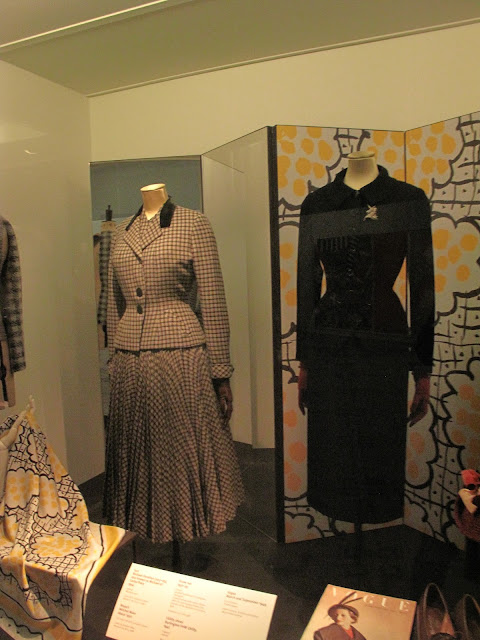
Glamorous 1950s fashions.


We have now reached the end of my photos from the gallery, and I hope that getting to look at the fashions of the past has inspired you to go to London to see it or sew a new historical costume or just do something exciting! (Watching a period drama wouldn't be a bad idea...) Clothing can teach us so much about the past and the people who lived through it, and I am indeed grateful to people who, like the V&A Museum, preserve things like this and put them out for all the world to see.


© 2015 Anna Morton